It usually hits you out of nowhere, you walk into the gym and realize it’s been months (or even years) since you worked out or trained.. You start wondering “what am I doing”, “how do I start working out again” or even “how do I start exercising without completely wrecking myself”.
I see this all the time with clients I train in East Vancouver.. Busy professionals, parents, and weekend athletes fall out of routine with work and family priorities, but then they hit that moment where they’re ready to come back, but don’t know where and how to to start.
You’re not behind. You’re not broken. You’re just restarting and there’s a smarter way to do it to make sure it's not just another flash in the pan.
The good news? Your body remembers more than you think. Muscle memory is real, and your past strength is still there under the surface, you just need the right approach to unlock it again.
Why It Feels So Hard to Come Back
There are two things happening at once when you start getting back into working out: your body feels worse than you remember, and your head gets louder.
Physically, the drop-off is real. Strength, coordination, and conditioning all slide faster than people expect. That’s why your first session back feels humbling, the weights feel heavier, your lungs burn faster, and movements feel less stable than they used to.
But the bigger barrier for most people is mental.
This is where gym anxiety shows up. A lot of people feel intimidated at the gym, especially after time off. You might feel like everyone’s fitter than you, everyone is watching you like the new kid in school,or that you’ve lost all your progress. I’ve had multiple clients tell me they sat in their car for 10 minutes before even walking into a big public gym, or just turn around and say” Maybe another day”.
And honestly, a lot of Vancouver gyms don’t help. They’re busy, crowded, and can feel overwhelming if you’re already unsure of yourself.
That’s actually one of the reasons we built Coast Athletics the way we did. Our East Van space is very private, personal training and small-group focused, and doesn’t have that packed, high-pressure feel. If the environment has been holding you back, that alone can make a huge difference. Contact us to learn more!
The key point: nothing you’re feeling is unusual. This is exactly where most people start when they decide to come back.
The Biggest Mistake People Make

The biggest mistake I see is people trying to pick up where they left off. They remember their old numbers, their old workouts, and they try to match them right away. It almost always backfires.
What actually happens:
You go too hard, too fast
You get brutally sore
Something starts to hurt (shoulder, back, knee)
You miss a few workouts… and fall off again
I had a client last year who used to deadlift regularly. Took about 8–10 months off, came back in, and wanted to start at ~80% of his old weight. We pulled him back to around 60%. He hated how light it felt at first.
Three weeks later? Moving better than ever, zero pain, and actually showing up consistently for the first time in a year.
That’s the difference. There’s a reason for this: after time off, your tissues lose tolerance faster than your brain loses memory of what you used to do.
So if you’re figuring out how to start working out again, this is the rule:
Start at 50–70% of your previous weights
Increase gradually (5–10% per week)
Always leave 2–3 reps in the tank (don't go fully to failure)
This is where muscle memory works in your favor. Even if it feels “too easy” that’s exactly where you should be.
A Realistic First 4 Weeks Back
This is where most people either build momentum or burn out. The goal of your first month isn’t to get super fit. It’s to rebuild consistency and tolerance.
Train 2–3x per week, full-body.
If you’re wondering how to start exercising without overcomplicating it, this is it.
Core Exercise Focus
These are some of the core movements I actually use with returning clients:
Goblet Squat (legs + core stability)
Dumbbell Row (upper back + posture)
Dumbbell Romanian Deadlift (glutes + hamstrings + core)
Half-Kneeling Dumbbell Press (shoulders + core + hip stability)
These hit everything you need, with low injury risk and high return.
4-Week Progression Plan
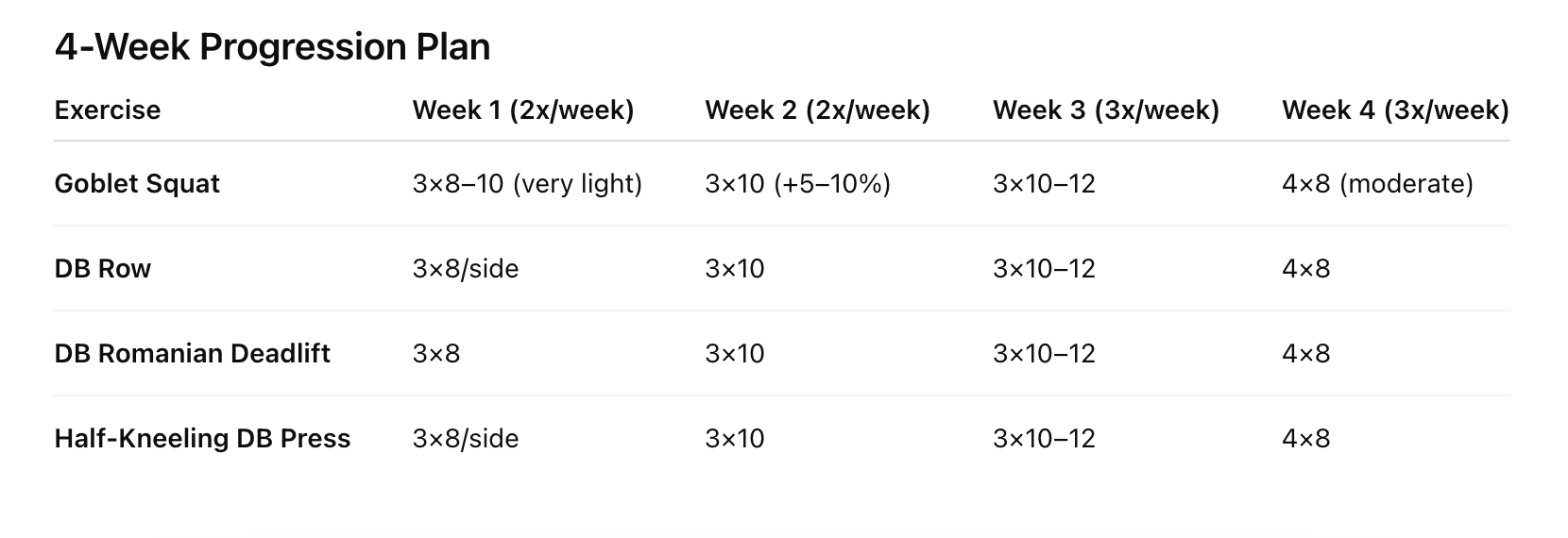
How to progress:
Add reps before weight
Increase load gradually
Stop every set with 2–3 reps left
You should leave the gym feeling better than when you walked in, not completely destroyed.
Also, if all you have is 30 minutes, that counts. That’s how consistency actually starts.
If you want more structure like this, this is exactly what we build into our coaching.
How to Stay Consistent This Time
Starting is easy. Staying consistent is where most people struggle. If you’re serious about getting back into working out for the long run, these are a few steps that can make the world of difference:
1. Lower the bar
Not every session needs to be perfect. A short workout still counts.
2. Set real attainable goals
Skip vague goals like “get in shape.”
Try: “Train 3x per week for 4 weeks.”
3. Build accountability
This is one of the biggest drivers of success. Whether it’s a coach, training partner, or small group, showing up becomes easier when you have someone or something to be accountable to.
4. Track something simple
Use an app or a notebook. Seeing progress on “paper” builds real exercise motivation.
5. Schedule it like it matters
You wouldn’t skip an important business meeting that's in your calendar would you?
If it’s not in your calendar, it won’t happen.
Most people don’t fail because they’re lazy, they fail because they don’t have structure.
Conclusion: Start Smarter, Not Harder
Getting back into training isn’t about going all-in on day one and gaining it all back in that one workout, it’s about building momentum.
If you’ve been stuck on how to start working out again, the answer is simpler than you think: start lighter, stay consistent, and follow a plan.
Your body remembers more than you think.
And if you want help navigating that restart phase, whether it’s guidance, accountability, or just a space that doesn’t feel overwhelming, that’s exactly what we do at Coast Athletics.
You don’t have to go at it alone.